


 A Gardenizi field guide
A practical no-bloom diagnosis
Healthy leaves. Still no flowers?
This guide helps you diagnose why a healthy-looking plant keeps making foliage instead of flowers. Check light, seasonal cues, pruning timing, roots, and feeding—then correct the one condition actually blocking bloom.
The useful shift
Leaves prove growth. They do not prove bloom readiness.
A plant can be green, vigorous, and completely healthy while spending its resources on roots, stems, and leaves. Flowering is a different developmental decision. It may require stronger light, a particular day length, cooler nights, mature growth, a rest period, or simply the right season.
That is why “add bloom fertilizer” is such an unreliable first response. Extra feeding cannot replace direct sun for bougainvillea, uninterrupted long nights for a holiday cactus, adequate light for a Phalaenopsis orchid, or last summer’s flower buds on a camellia branch that was just sheared away.
The aim is not to force every plant on your schedule. It is to identify which gate has not opened—and avoid damaging the buds while you wait.
A plant does not make flowers because we want flowers. It flowers when its stored energy, season, signals, and bud-bearing tissue line up.
Healthy enough?
Working roots, mature growth, and sufficient leaf area give the plant resources to reproduce.
Enough light?
Light intensity and duration determine how much energy the plant can build over time.
Right season?
Temperature, night length, drought rhythm, or growth maturity may trigger the switch to buds.
Buds still there?
Flowering occurs at particular tips, nodes, spikes, or ages of wood that pruning can remove.
The no-bloom diagnosis
Check in this order—not all at once.
Change one major variable at a time. If you move the plant, repot it, prune it, feed it, and alter watering in the same week, you lose the evidence that would tell you what helped or hurt.
Name the plant precisely.
“Orchid,” “cactus,” and “camellia” are categories, not schedules. Identify the genus or type and, when possible, the cultivar. Thanksgiving, Christmas, and Easter cacti do not share the same natural bloom window.
Evidence to collect
Plant label, leaf or segment shape, past bloom month, and whether it was sold already flowering.
Separate “never” from “not yet.”
A mature plant that bloomed last year but not this year suggests a changed condition. A seedling, recent division, new cutting, or recovering transplant may simply be immature or rebuilding.
Evidence to collect
Age, propagation method, repotting date, last bloom, and recent stress.
Audit the real light.
Do not judge by how bright the room feels. Record when direct sun reaches the leaves, how long it remains, and what shades the plant across the season.
Evidence to collect
Morning, midday, and late-afternoon photos from the plant’s position for several clear days.
Find the seasonal trigger.
Some plants need a temperature change or long uninterrupted nights. Others bloom after a new-growth flush matures. A continuously warm, lit room can erase the signal.
Evidence to collect
Night temperature, nearby lamps, vents, outdoor exposure, and the normal local bloom season.
Locate the future flowers.
Look for terminal tips, plump flower buds, spike nodes, or new shoots before pruning. A cut can improve structure and still remove the next bloom.
Evidence to collect
Close photos of buds and nodes, plus the date and position of every recent cut.
Inspect roots and feeding last.
A saturated, airless root zone can stall the whole plant. Heavy nitrogen feeding can favor leaves. Neither problem is diagnosed by leafiness alone.
Evidence to collect
Drainage time, root condition when genuinely due for repotting, product label, dose, and application dates.
Light has two jobs
One plant counts brightness. Another counts darkness.
Bougainvillea uses strong direct sun to build the energy behind repeated growth and bloom cycles. A vine kept in comfortable shade may remain leafy without producing much color. Many Phalaenopsis orchids also fail to rebloom when indoor light is too low, although they need bright filtered light rather than bougainvillea’s exposed sun.
Holiday cactus presents a different problem. During its bud-induction period, light at the wrong time can matter as much as light intensity. Warm evenings and a lamp that interrupts the dark period can keep the plant vegetative even when daytime light looks adequate.
Do not move straight from shade to harsh sun. Increase exposure gradually and follow the needs of the species. Sunburned leaves do not create a better flowering plant.
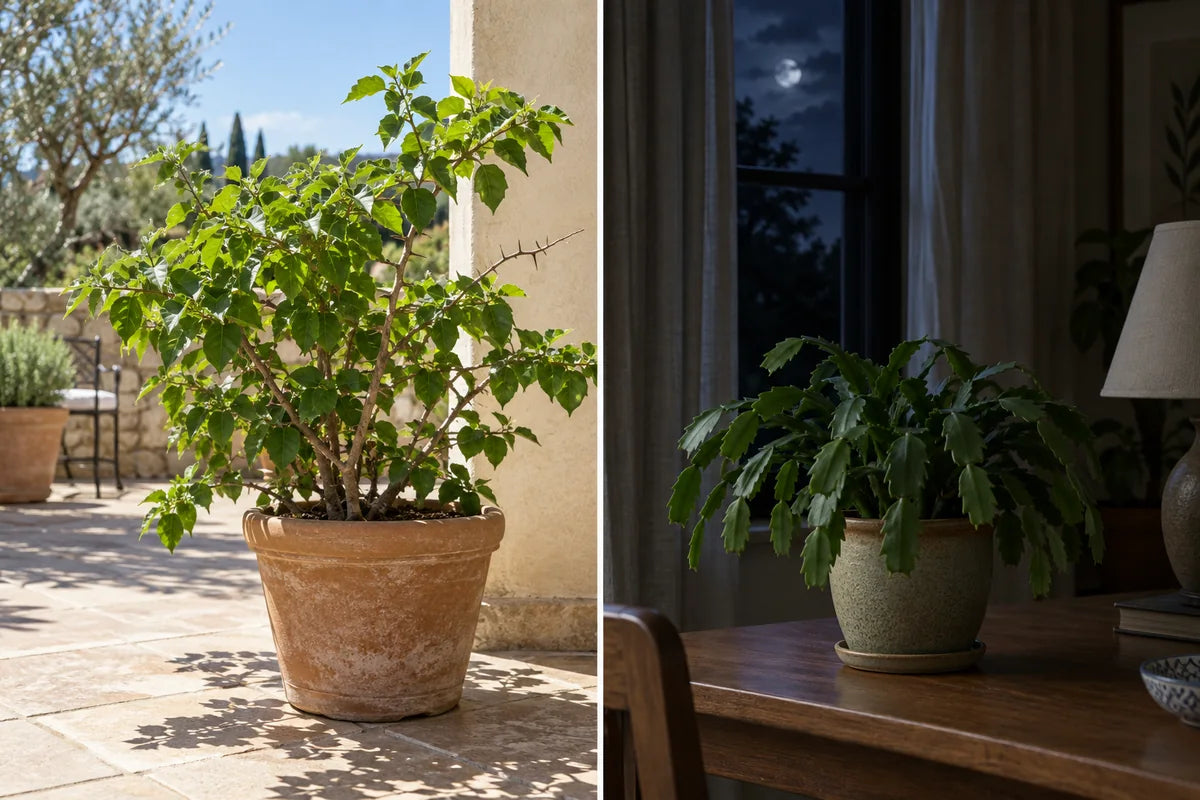
Illustrative light signals. Bougainvillea needs useful daytime intensity; holiday cactus needs bright days plus the correct cool, uninterrupted night period for bud induction.
The plant’s clock
Do not confuse a leaf phase with a failed flower phase.
Many flowering plants alternate jobs. They build structure, mature it, receive a seasonal signal, form buds, and only then open flowers. The sequence may be obvious on a woody shrub and nearly invisible on a houseplant.
Leaves and roots
Fresh leaves, new roots, and elongating stems are useful. They become a problem only when conditions keep the plant vegetative indefinitely.
Tissue changes
A soft new shoot may need to harden; an orchid may need to finish a leaf; a camellia’s spring growth later carries flower buds.
The cue arrives
Light level, long nights, cooler temperatures, or a drying rhythm can shift the plant toward reproductive growth.
Buds develop
Stable moisture, suitable temperature, and restraint with moving or pruning keep formed buds attached until bloom.
The bud has an address
Before you cut, know where the next flowers live.
“Pruning encourages flowers” is incomplete advice. The result depends on which plant, which tissue, and which date. A useful cut preserves or creates the right structure; a badly timed cut removes it.
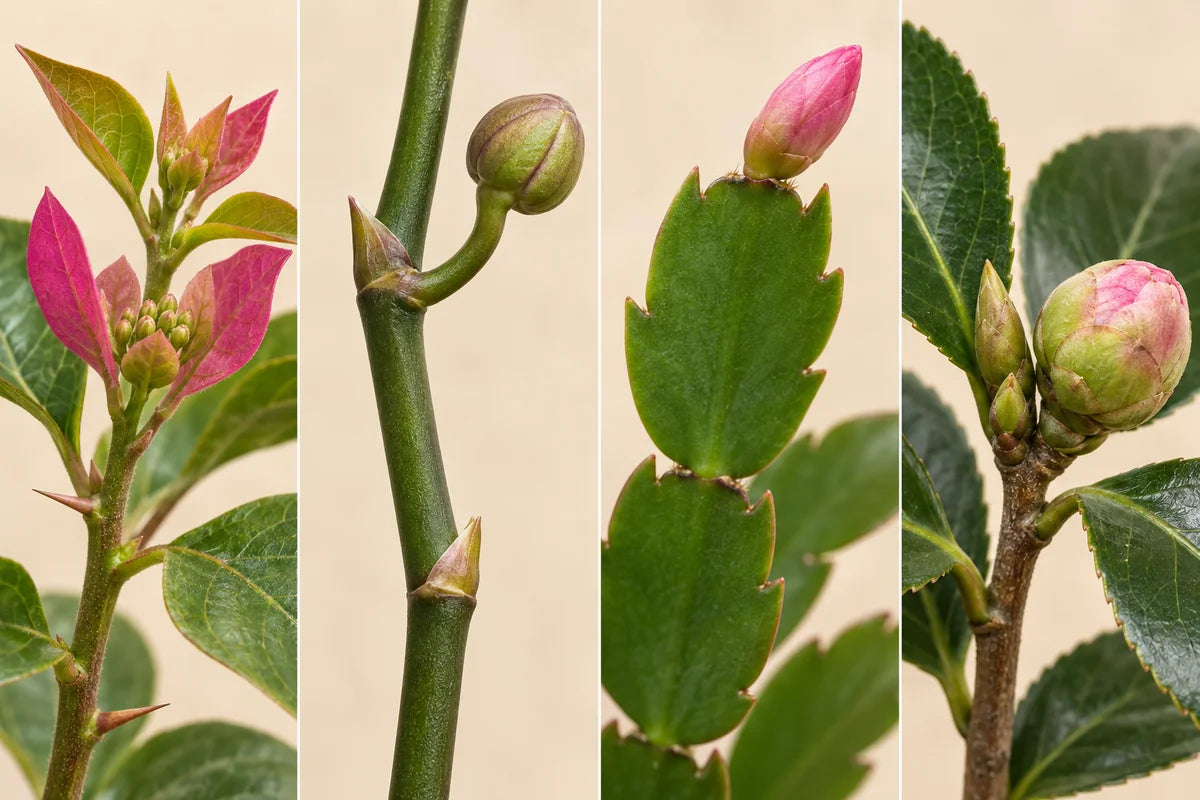
Current growth
Color develops with new growth cycles. Constant tip-cutting can repeatedly remove the shoots that would carry the next bracts.
Spike nodes
A healthy green old spike may branch from a dormant node. A brown, dry spike is finished. Plant health and type decide whether keeping it is useful.
Terminal segments
Buds form at the ends of mature segments. Pinching during or after induction can remove the exact terminals preparing to flower.
Mature older wood
Rounded flower buds develop months before bloom. Late shearing can quietly remove a season’s display while leaving a tidy green shrub.
Four plants, four different answers
The flower tells you what the plant had to prepare.
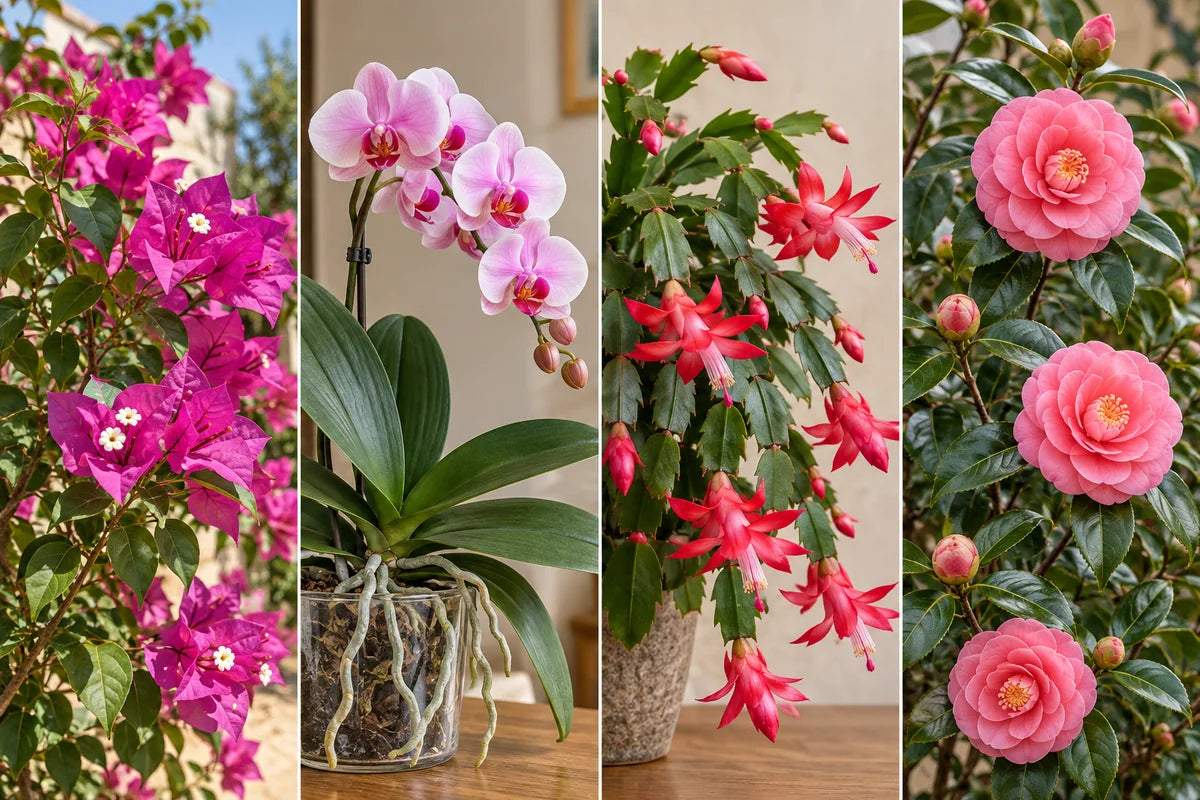
Sun-driven cycles
Bougainvillea
A lush vine with no color is often receiving less direct sun than its leaves suggest, too much frequent irrigation, excessive nitrogen, or repeated pruning that interrupts new growth.
- Check first
- Direct sun at the plant’s actual location, drainage, irrigation reach, and how often tips have been cut.
- Useful move
- Increase sun gradually where climate allows, let the root zone approach its species-appropriate drying point, and allow a healthy flush to mature.
- Wait if
- The plant is recovering from cold, root disturbance, a hard prune, or a recent move into stronger light.
- Avoid
- Stacking fertilizer, keeping soil continuously wet, or clipping every extending shoot because it looks untidy.
Light + maturity + temperature
Phalaenopsis orchid
A healthy moth orchid may spend months producing leaves and roots before a spike. Low indoor light is a common barrier; some plants also respond to cooler fall nights after growth matures.
- Check first
- Firm leaves, live roots, the newest leaf’s maturity, window direction, and whether the emerging structure is a rounded root tip or flattened flower spike.
- Useful move
- Provide brighter filtered light and a stable care routine. Where safe for the plant, allow the normal seasonal day-to-night temperature difference.
- Wait if
- A new leaf or root flush is still active. That vegetative work may be the plant’s present phase, not a failure.
- Avoid
- Direct midday scorch, fertilizer concentration, cutting a green spike without a reason, or leaving a dry brown spike attached indefinitely.
Long nights + cool conditions
Holiday cactus
Many Christmas and Thanksgiving cactus cultivars need several weeks of long uninterrupted nights and cool temperatures to initiate buds. A warm living room lit late every night can keep them growing segments.
- Check first
- The exact holiday cactus type, nighttime light leaks, room temperature, and whether small buds already sit at segment tips.
- Useful move
- During the correct induction period, provide bright daytime light, cool nights, and roughly 12–14 hours of uninterrupted darkness as the cultivar guidance requires.
- Wait if
- The plant is still in summer growth or the required induction period has not been completed consistently.
- Avoid
- Moving, rotating, drying hard, flooding, or exposing a budded plant to drafts and abrupt heat.
Protect next season’s wood
Camellia
Camellias commonly form flower buds during the growing season before they bloom. A shrub can look dense and green after late shearing yet carry far fewer flower buds.
- Check first
- Species or cultivar, its normal bloom season, rounded flower buds versus pointed leaf buds, and the date of the last prune.
- Useful move
- Prune, if needed, soon after that plant finishes flowering and before the next buds are set. Favor selective thinning over routine shearing.
- Wait if
- Flower buds are already visible. Concentrate on steady moisture and protection from weather extremes.
- Avoid
- Late-summer or fall shaping, severe restructuring in one season, and assuming every dropped bud means disease.
Pruning is a timing decision
Cut for structure only after you map the buds.
Dead, damaged, or dangerous wood is a separate decision. For ordinary shaping, first identify the flowering window and bud-bearing tissue. Camellias are usually safest to shape soon after their own bloom ends. Bougainvillea can be trained and selectively pruned, but repeated hard or late cutting can postpone color. Holiday cactus is best pinched for branching well before bud induction—not while terminal buds are forming.
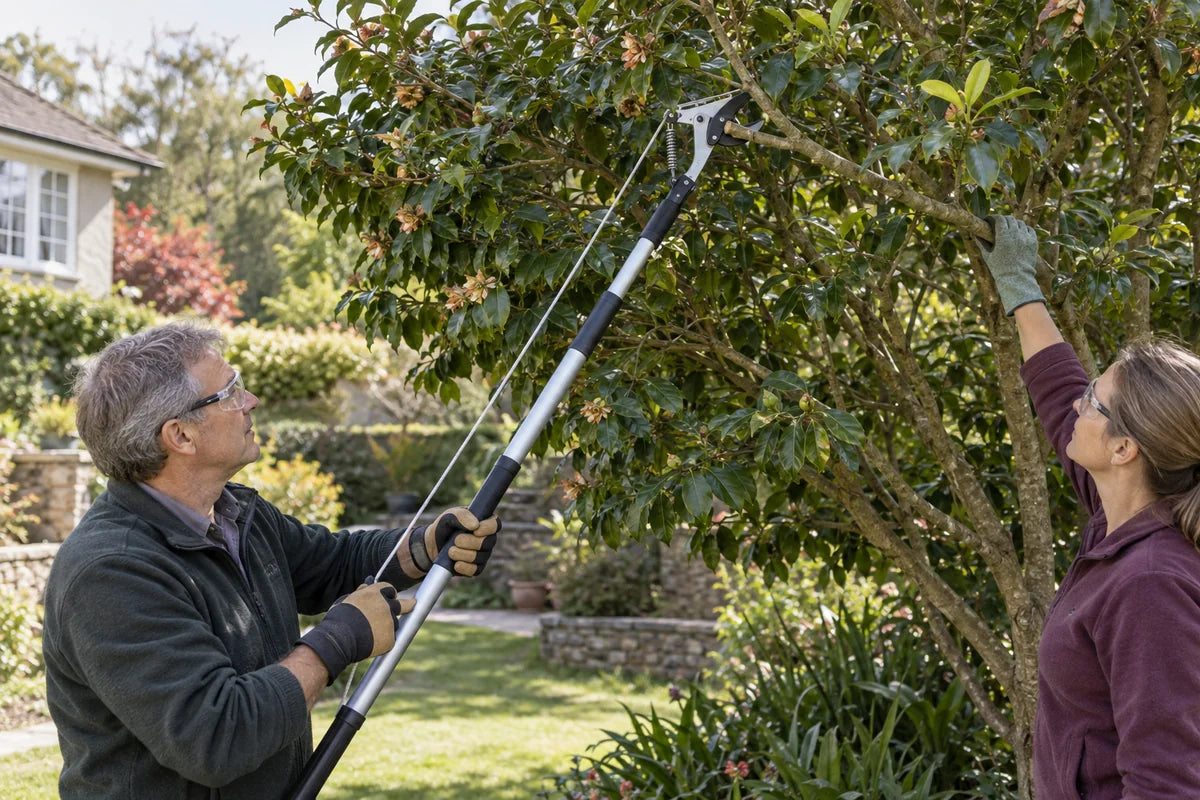
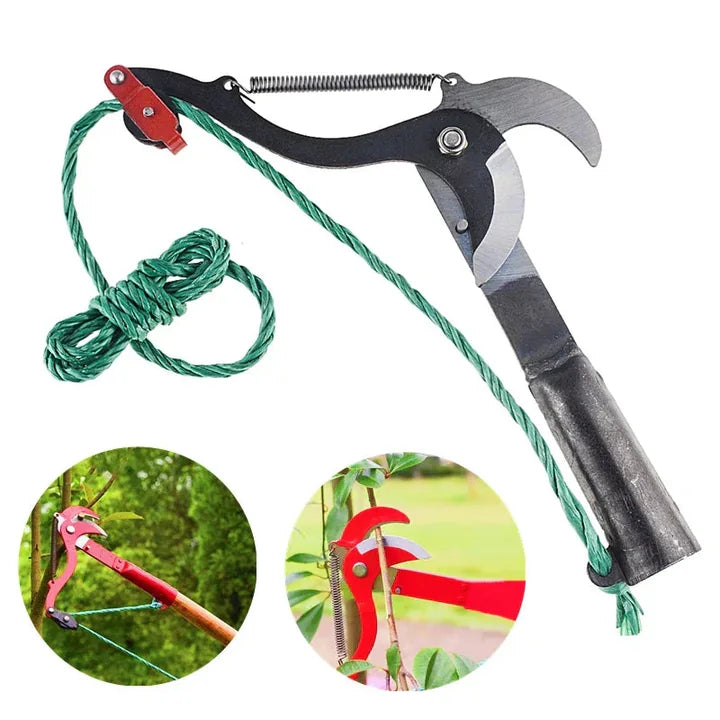
For one appropriate branch above easy reach
Reach the cut without climbing into the canopy.
This rope-operated lopper head attaches to a compatible pole so the operator can make a selective cut from stable ground.
- Use it when: the plant’s safe pruning window is confirmed, the target is a modest high branch within tool capacity, and the cut improves a real structural problem.
- How: identify the lateral branch and bud position, clear the drop zone, wear eye protection, support the light branch, and make one controlled cut.
- Its role: access and control for a specific elevated cut—not automatic flower stimulation.
- Do not use it: near power lines, on thick or heavy limbs, over people, without a secure compatible pole, or merely because a plant has not flowered yet.
The root-zone question
Repot only when the medium—not your impatience—requires it.
A plant with damaged roots cannot support a reliable bloom cycle. But repotting is also a disturbance, and some plants flower best when their roots are comfortably established. Look for a real reason: collapsed medium that stays airless, roots in decline, water that no longer enters evenly, or a container that is genuinely unsuitable.
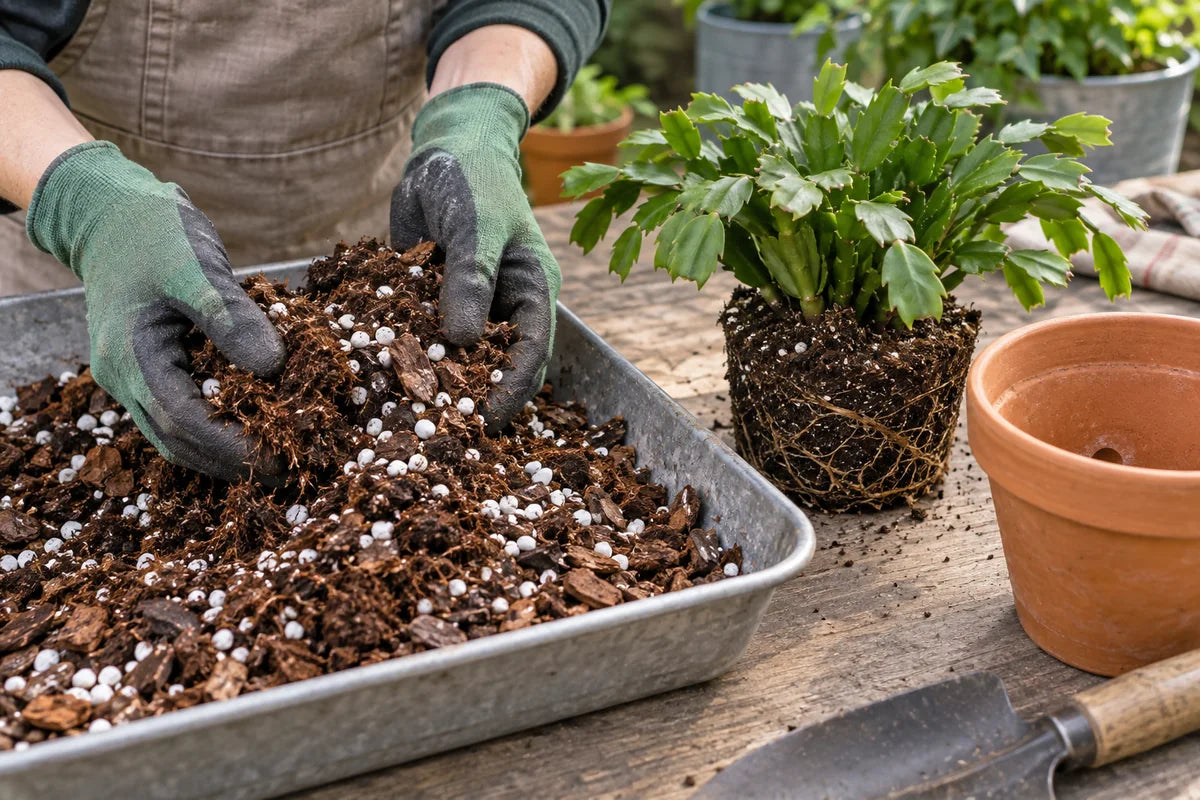
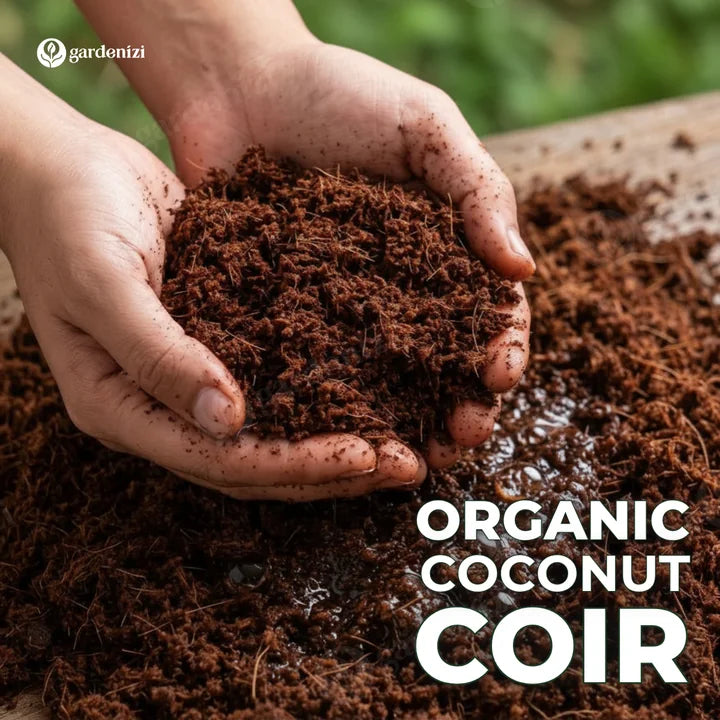
Optional growing-medium component
Use coir to build texture—not to trigger flowers.
Hydrated, fluffed coconut coir can contribute moisture-holding fiber to a species-appropriate container mix. For a holiday cactus, that may mean a modest share combined with coarser materials so air and drainage remain available.
- Use it when: repotting is genuinely due and the planned mix needs a clean, fibrous, moisture-retentive component.
- How: hydrate fully, drain free water, fluff, and blend with coarse ingredients in proportions suitable for the exact plant and climate.
- Its role: physical moisture management and structure—not fertilizer, bloom booster, or a substitute for drainage holes.
- Do not use it: as a tightly packed single medium around epiphytic roots, in a pot that already stays wet, or as a reason to repot a healthy budded plant.
A calmer reset
Give the plant one complete, observable cycle.
The reset is not a universal number of days. It is a period long enough to see the next species-relevant checkpoint: a mature leaf, a completed holiday-cactus induction period, a new bougainvillea flush, a Phalaenopsis spike season, or camellia bud set.
Fix the baseline
Photograph the whole plant, growing tips, buds, roots if visible, and its light at three times of day.
Stop stacking changes
Keep watering, placement, and temperature consistent enough to read the plant’s response.
Change one gate
Address the strongest evidence first: light, night interruption, drainage, or pruning timing.
Read new structures
Distinguish a root from a spike, a leaf bud from a flower bud, and new bracts from ordinary leaves.
Use the checkpoint
If the expected structure still does not appear, reconsider the diagnosis rather than simply increasing fertilizer.
What the pattern is telling you
Match the symptom to the next check.
Lush, stretching growth
Long gaps between leaves, leaning toward a window, and soft extension suggest light may be limiting even if leaf color is green.
Check next
Usable light at the leaves and whether high-nitrogen feeding is adding vigor without solving the energy problem.
Compact growth, no seasonal buds
The plant may be healthy but missing its induction signal or simply outside its flowering window.
Check next
Night temperature, uninterrupted darkness, mature growth, and the normal schedule for the exact type.
Buds form, then disappear
The flowering decision happened. The problem now is bud retention rather than initiation.
Check next
Moves, drafts, heat, cold, drought, saturation, root stress, and abrupt changes in light.
Flowers only on the unpruned side
The pattern strongly suggests bud-bearing tissue was removed or the cut side is rebuilding structure.
Check next
Pruning date, cut position, and whether that plant flowers on current growth, older wood, terminal tips, or spikes.
Many camellia buds, few open
Bud formation succeeded, but drought stress, warm spells, freeze injury, excessive bud load, or other stress can prevent normal opening.
Check next
Weather history, even moisture during bud development, and whether the cultivar fits the local climate.
Roots decline while leaves linger
Leaves can remain green for a time after root conditions become poor. Flowering is unlikely to be the plant’s priority.
Check next
Drainage, root firmness, odor, medium breakdown, and watering frequency. Stabilize roots before pursuing flowers.
Quick answers
Questions to settle before buying a bloom booster.
Does phosphorus force flowers?
No fertilizer can replace missing light, maturity, or a seasonal signal. Use nutrients according to plant need and a product label; excess fertilizer can injure roots or produce imbalanced growth.
Should I stop watering to make a plant bloom?
Only plants with a supported species-specific drying cue should receive that treatment. Droughting a Phalaenopsis, camellia, or budded holiday cactus can cause damage or bud loss.
Should I cut a Phalaenopsis spike after flowering?
A dry brown spike can be removed. A green spike may branch from a node, but keeping it is optional and depends on plant vigor, appearance, and the grower’s goal. Do not confuse a spike with a root.
Why does my holiday cactus bloom at Thanksgiving?
It may be a Thanksgiving cactus rather than a true Christmas cactus, or its cultivar and conditions may produce an earlier schedule. Segment shape and bloom timing help with identification.
Will a bigger pot make more flowers?
Not automatically. Extra wet medium around a small root system can create trouble, and unnecessary repotting can interrupt an established cycle. Change pot size for root and water-management reasons.
Can I prune while buds are visible?
Remove dangerous or diseased material when necessary, but ordinary shaping at that stage sacrifices visible or hidden flowers. Wait until the species-appropriate post-bloom window.
How long should I wait?
Wait for the next meaningful biological checkpoint, not an arbitrary deadline. That may be a completed leaf, several weeks of correct long nights, maturation of new growth, or the normal bud-setting season.
What if the plant has never flowered?
Confirm identity, age, propagation history, and minimum cultural needs. A seed-grown or recently propagated plant may need more maturity than a purchased flowering specimen.

While the garden waits for its next bloom
Christmas is coming—add color without rushing the plant.
The Twinkling Solar Snowman Flag brings a cheerful winter focal point while camellia buds swell and holiday plants follow their own schedule. Place it where the solar panel receives useful daylight and where the flag will not shade plants, block paths, or interfere with watering.
Decorate with the Solar Snowman FlagThe rule to remember
Do not push for flowers until you know where the plant is in its cycle.
Give it the right energy, the right signal, and time to build the right tissue. Then protect the buds that prove the message was received.
Maya Collins · Gardenizi