


A practical decision guide
The Bougainvillea Pruning Decisions That Change the Whole Plant
A bougainvillea does not need “a prune.” It needs the right answer for one branch: make it bushier, make it shorter, make space, or give it somewhere to go.
 Garden notes for deliberate growth
Start here
Before cutting, stand back. Bougainvillea can be shaped as a shrub or trained along a support, and it flowers on new growth. That does not make every new shoot a candidate for removal.
First decide what the branch is doing now. Then choose the smallest action that solves that job.
- Is it healthy, damaged, or clearly dead?
- Does it point outward, crowd the center, or cross another branch?
- Is it a flexible young shoot—or already a stiff woody cane?
- Is the plant actively stressed, recovering, or carrying a flowering flush you want to enjoy?
Name the action before you make it
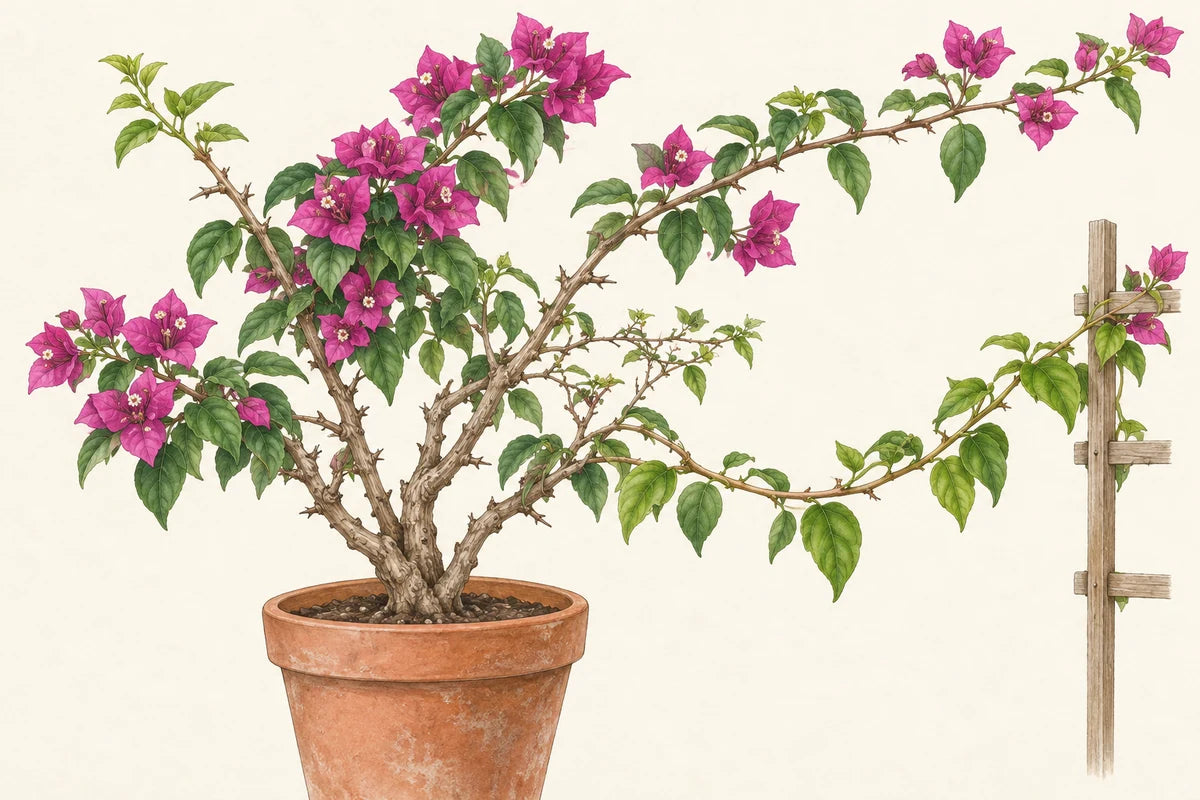
Four different decisions. Four different plant shapes.
 Tip prune Shorten Thin Train
Illustrative branch map. The leader labels point to a growth situation, not an automatic instruction for every branch.
- Tip prune: fresh outward tip
- Shorten: overlong outer shoot
- Thin: crowded inner twig
- Train: flexible shoot near support
01 / Make it branch
Tip prune
Remove only the soft end of a healthy, outward-facing young shoot when you want more side growth and a fuller outline.
Skip it when the shoot is your useful future framework, the plant is visibly stressed, or you are repeatedly clipping every new tip without a shape in mind.
02 / Reduce its reach
Shorten
Take length from a branch that has escaped the intended scale. Cut back to a sound node or side shoot that faces the direction you want future growth to take.
Skip it if the real problem is crowding at the base. A shorter crowded branch is still a crowded branch.
03 / Make room
Thin
Remove a dead, damaged, rubbing, weak, or inward-growing branch at its point of origin when the center needs clearer structure.
Skip it as a ritual. Thinning is for a specific obstruction; it is not a reason to hollow out a healthy plant.
04 / Change its route
Train
Keep a long young shoot when it is flexible enough to guide toward a trellis, fence, or support. The goal is placement—not a promise that bending alone will cause bloom.
Skip it once a cane resists bending. Forcing a woody, thorny branch can tear bark or snap growth you meant to keep.
A real-world sequence
When a pot feels crowded and one shoot runs away
-
1
Clear the obvious problems first. Remove only dead, damaged, or truly crossing growth. That is thinning—not a haircut.
-
2
Choose the future outline. Keep an outward shoot if it fills an empty side. Shorten it only if its length is what breaks the plant’s scale.
-
3
Make a route for a pliable shoot. If a long young cane can reach a support without forcing it, training may preserve useful growth instead of cutting it away.
-
4
Pause before a second round. Let the plant show where new growth emerges. Repeated hard cutting can trade a graceful framework for dense foliage and fewer flowers.
Timing is not one calendar date
Climate, cultivar, and growth stage change the response.
In warm climates, bougainvillea may move through more than one growth and flowering cycle. In cooler areas, a plant’s recovery window and outdoor season are shorter. Use the current plant—not a generic month—as your first timing cue.

For the branch you decided to keep
Support the route. Do not squeeze the stem.
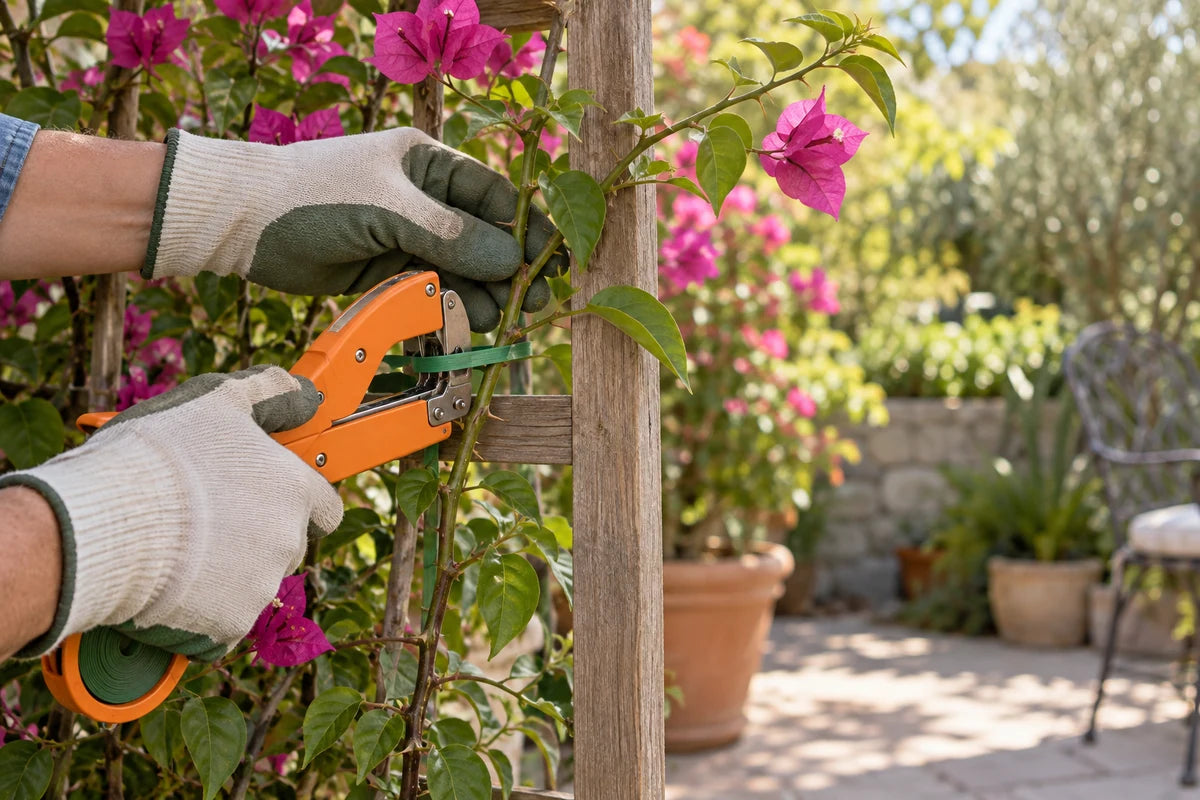
If you have chosen to train several flexible shoots, a plant tying machine can be a practical convenience for attaching them to a support. It is not a pruning tool, and it does not decide which branches belong on your plant.
Make each tie loose enough that the shoot has room to thicken. Recheck ties as growth continues, especially during a fast flush.
Explore the Plant Tying MachineAffiliate disclosure: Gardenizi may earn a commission if you buy through this link, at no added cost to you.
One final rule
Prune toward a shape you can name.
Before every cut, say what it will do: branch, shorten, clear, or train. If you cannot name the result, leave that branch alone until you can.